Mediterranean Interior Design: how to bring the mediterranean to your home


4. Materials & Textures
5. Furniture

1. What is mediterranean Interior Design?
Imagine opening your balcony door on a morning and feeling a warm, gentle breeze drift through the room. The sun casts golden stripes across whitewashed walls, somewhere there's the scent of fresh herbs in the air – and you're right in the middle of that feeling from your last holiday.
The Mediterranean style is not a rigid set of design rules – it's a way of life. It brings together influences from the countries surrounding the Mediterranean Sea: sun-drenched Greece, rustic Italy, colourful Spain, and the sensual, playful world of Morocco. Each of these countries adds its own flavour, but they all share the same core: warmth, naturalness, and a relaxed generosity in the way they approach space and material.
What fascinates me most about this style is its honest simplicity. Nothing here is overdone or perfectly staged. A slightly weathered wooden table, handmade ceramics, a few wild herbs in a terracotta pot are all it takes to completely transform a home. The Mediterranean style celebrates the imperfect, the lived-in, the authentic.
The core principles are wonderfully simple: you work with natural materials, you let in the light, you choose warm and earthy colours – and you create rooms where people immediately feel at home.

2. Wall Paintings: The Oldest Form of Mediterranean Wall Decoration
When I think about the roots of Mediterranean interior design, I inevitably find myself drawn to two places that have fascinated me for years: Pompeii and the Minoan palaces of Crete and Santorini. Both have left us something incredibly precious – an unfiltered glimpse into the interior world of Mediterranean living culture that has endured for thousands of years.
Let's start in Crete. The Minoans, that mysterious Bronze Age civilisation, created frescoes in their palaces and houses that still take your breath away today. Leaping dolphins arcing over blue waves. Young women with curly hair and precious jewellery, laughing and dancing. Nature and wildlife in lush, vibrant scenes – birds, flowers, sea creatures in colours that still glow after more than three thousand years. These people had a lightness and a joy in life that you can feel in every line. Their art is playful, elegant, and deeply life-affirming – and it is, I am convinced, the earliest expression of that Mediterranean way of life that captivates us to this day.
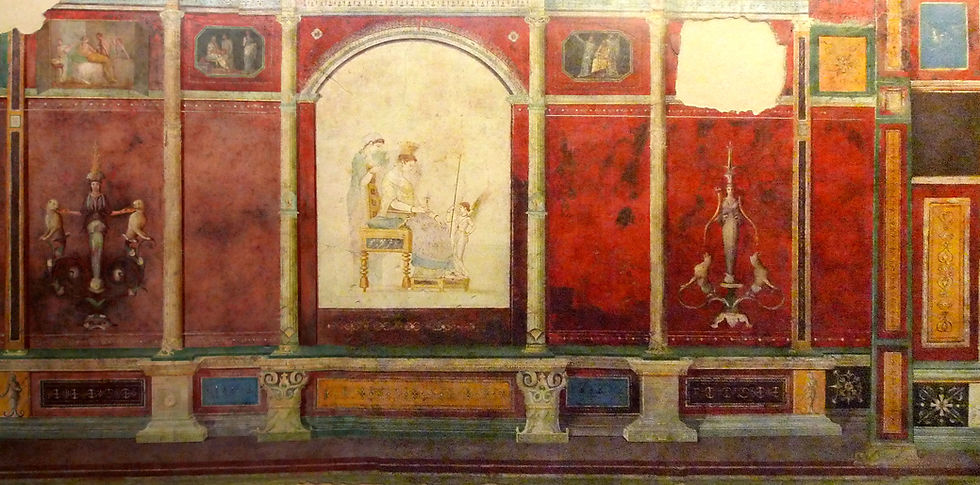
Then there is Pompeii. This city, buried by Vesuvius in 79 AD, has given us a unique insight into the everyday life of the Roman Mediterranean world. The walls of Pompeian villas were not bare surfaces – they were stages. Lush garden landscapes stretching across entire walls and dissolving the boundaries between inside and outside. Mythological scenes in vivid colours – ochre yellow, Pompeian red, deep green, black. Delicate architectural paintings creating the illusion of columns, arches, and sweeping views into imaginary landscapes. These people knew exactly what they were doing: they used paint and brush to create a world in which they wanted to live.
What moves me so deeply about both cultures is the directness of this art. No frame, no distance. People literally lived within these images, ate beneath them, entertained guests in front of them, dreamed beside them. That is an intimacy with art that we barely know today.
And this is where it gets really exciting for me as a modern decorator: because this concept translates beautifully into today's home. Hand-painted copies – whether based on Minoan originals with their playful sea scenes and dancing figures, or on Pompeian motifs with their rich, dramatic colour – bring a depth and originality to a room that no poster or print in the world can achieve. The hand-crafted is here not just a stylistic choice, but an attitude: a decision in favour of the real, the unique. Such a wall hanging is not just decoration. It is a window into a world that, thousands of years ago, was just as warm, alive, and beautiful as the one we are trying to create today.

3. Colours and Atmosphere
When I think about Mediterranean colours, I immediately see the images: the brilliant white of the houses on Mykonos, the deep blue of the sea, the red-brown rooftops of Tuscan hilltop villages, the warm ochre of sandstone facades in the Provençal midday sun. This palette is no accident – it is the direct reflection of a landscape that has captivated people for thousands of years.
The foundation is usually made up of warm earth tones: terracotta, sandy beige, creamy white, and warm ochre. These tones flatter every room and instantly create a cosy, almost sensual atmosphere. They soften walls, make spaces feel larger, and provide a wonderful backdrop for all the beautiful details still to come.
The famous Mediterranean blue then comes into play as an accent colour – a deep cobalt on a ceramic pot, a faded turquoise blue on an old wooden chair, a bold indigo in a rough linen cushion cover. These blue tones work like a window to the sea – they refresh the warmth of the earth tones and bring exactly the right touch of vibrancy to the room.
Then there are the greens, reminiscent of olive trees, pines, and wild herbs: muted, slightly greyish greens that are never too loud but always present. And of course there is the white – not the cool, sterile white of minimalist design spaces, but a broken, warm white that looks like the plastered walls of an old cottage.
What makes this colour palette so special is its relationship with light. Mediterranean colours are literally made for sunlight – they respond differently at every time of day, glowing golden in the morning, warm and radiant at midday, and shimmering in a soft, almost magical light in the evening. But don't worry: even in our more northerly latitudes, where sunshine can be scarce, these tones still work their magic. Warm light sources like candles, brass lamps, or warm white LEDs replace the sunshine effortlessly – and suddenly your living room has something of a Sicilian kitchen on a long summer evening.

4. Materials & Textures
If there is one single aspect that sets Mediterranean style apart from so many other interior design concepts, it is the devotion to natural materials. Here you will find no plastic, no high-gloss fronts, no artificial surfaces. Instead: wood, stone, clay, linen, cork, rattan – materials that the earth itself has produced and that only grow more beautiful with each passing year.
Wood plays a central role – in the literal and figurative sense. But not just any wood: it's the old, weathered, knotted timbers you imagine when you think of an ancient olive tree that has stood in the southern Italian sun for centuries. Reclaimed wood, driftwood, bleached floorboards – all of this fits perfectly into this concept. Imperfections are not flaws, they are character.
Then there is stone. Whether as rough sandstone flooring, a marble countertop in the kitchen, or a rustic rubble stone wall in the living room – stone brings a permanence to a space that combines beautifully with the airiness of the colours. Terracotta in particular is for me the unsung hero of the Mediterranean style. As a floor tile, a flower pot, a bowl on the dining table: terracotta always looks as though it has always been there.
When it comes to textiles, rough and uneven is perfectly welcome. Linen is the absolute favourite material of the Mediterranean style – loosely woven, slightly crumpled, in muted natural tones. Add to that hand-woven cotton rugs, cushion covers and blankets with traditional patterns. The more you bring a sense of craftsmanship and handwork into your space, the more authentic and genuine the atmosphere becomes.
And perhaps the most beautiful thing about these materials is that they age wonderfully. Bought once, it can be a lifelong companion.

5. Furniture
Mediterranean furniture has a quality that I find endlessly fascinating: it looks as though it already has a whole life behind it – and is all the more inviting for it. There is no room here for stiff, flawless showroom furniture. What counts is substance, warmth, and the unmistakable hallmark of time and craftsmanship.
The most characteristic furniture pieces of the Mediterranean style are solid, grounded, and often reduced to the essentials. Whether a dining table of solid wood for 12 or a small garden table - eating here is not a quick affair, but an event. Add chairs that don't all have to match: This deliberate lack of uniformity is not a mistake – it is the whole point.
Rattan and wickerwork are equally indispensable. A rattan armchair in a reading nook, a woven tray on the coffee table, a basket chair on the balcony – these elements instantly bring lightness and a southern flair to any room.
Another feature I notice again and again: Mediterranean interiors love open shelving and visible storage. Beautifully stacked ceramic plates, wine glasses, books, baskets – all of this becomes part of the decoration. There are no hidden, tidied-away surfaces behind which real life disappears. Life itself is the interior design.
6. Decorative Elements & Accessories
Now we dive into my absolute favourite part – the details. Because a room only gets its soul through the right accessories.
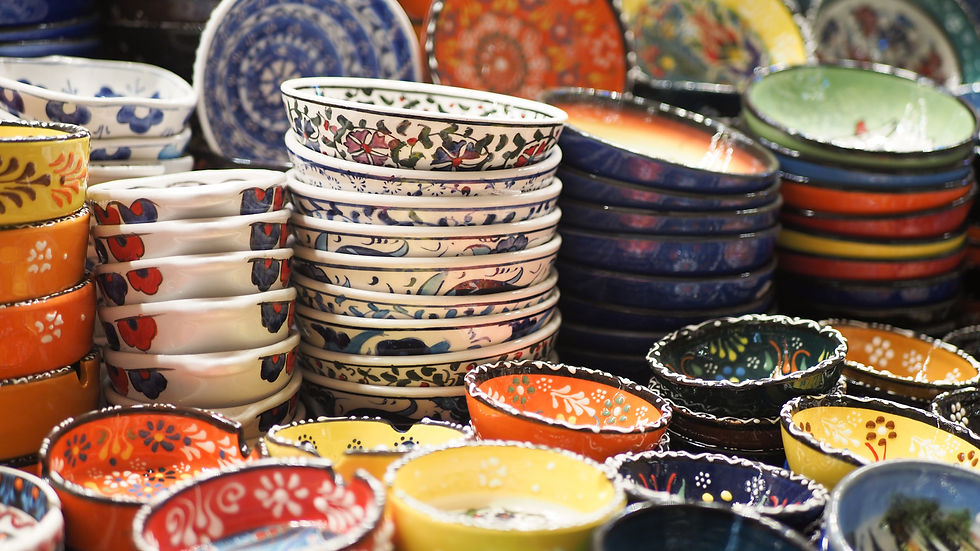
Ceramics top the list. Handmade ceramics, ideally with small irregularities, playful patterns, or rich Mediterranean colours – cobalt blue, olive green, sunny yellow, terracotta. That is all it takes to completely transform a room.
Mosaics and tiles are another magical element. Whether as an accent in the kitchen, as a tabletop, or as a decorative panel in the bathroom – tiles with geometric or floral patterns instantly bring Mediterranean flair – and they make any room something truly special.
Then there are the plants – and Mediterranean style really cannot do without them.
People living in Mediterranean countries, of course, have lush greenery right on their doorstep all year round. And what about us in the cold north? We simply bring it indoors! For those with enough space and sunlight: olive and citrus trees, bay laurel, and perhaps a bougainvillea on the façade? For everyone else, lavender, thyme and rosemary bring the scent of the south into our home.
When it comes to lighting, my heart beats a little faster. Candles of all sizes, rustic lanterns in brass or blackened iron, fairy lights on the balcony, oil lamps on the dining table. The light is warm, it is soft, it flickers a little – and it transforms every evening into a small celebration.

7. Shopping-Tipps & Budget
What I particularly love is the Mediterranean approach to vintage and found objects. An old apothecary cabinet now serving as a sideboard. An antique chest as a coffee table. A weathered wooden stool repurposed as a side table. Flea markets and antique fairs are a true goldmine for Mediterranean decorators – because there you find exactly the pieces that no furniture chain in the world can reproduce: the original, the organic.
So here is my first and most important tip: go to flea markets and second-hand shops. I cannot stress enough how many Mediterranean dream pieces are waiting there for you!
If you prefer to buy new, it is worth seeking out smaller, craft-oriented brands. Many of them work with artisans in Spain, Portugal, Morocco, or Turkey and offer genuinely authentic pieces at fair prices. Etsy is also a fantastic source for handmade ceramics, textiles, and decorative items – directly from the people who made them with their own hands.
And if you're as captivated by antique wall paintings as I am, do take a look at my shop: there you'll find hand-painted copies of Mediterranean wall paintings – from Minoan frescoes to Pompeian motifs.
Another option I highly recommend: bring pieces back from your holidays – these are the things that give your interior something truly personal and unrepeatable.
If the budget is really tight, focus on the affordable adjustments with the biggest impact: new linen cushion covers, a few ceramic bowls, fresh herbs in terracotta pots, and warm fairy lights. With very little money, you can bring a surprising amount of Mediterranean flair into your home. The Mediterranean style is, in a sense, democratic: it does not demand a perfect interior, just an authentic one.
And those with a little more financial leeway combine the two: luxurious, one-of-a-kind pieces from artisans and authentic favourites from the local flea market.
Start your journey to mediterranean interior design today and let yourself be inspired here and in my shop!



Comments