Colours of Antiquity: Red like Pompeii, Blue like Egypt and Green like Crete


1. Colours that last millennia
Imagine you are standing in one of the excavation houses in Pompeii. The sun streams through an opening in the wall onto a surface – and the surface glows in return. You discover deep red, warm ochre or a delicate, otherworldly blue. Painted almost two thousand years ago, buried under volcanic ash in 79 AD and only rediscovered centuries later – and still as vivid as if the paint had been applied only yesterday.
How is this possible? The answer lies in the pigments and binders used by ancient painters. Long before industrially manufactured paints existed, people developed a deep understanding of which minerals and metals produce which colours – and how to process them so that they adhere, shine and endure.
This article takes you on a journey through the fascinating world of ancient pigments – from the Minoan palaces of Crete to the buried villas of Pompeii. It is a story of earth, fire, chemistry and craftsmanship – and sometimes of poison.
2. An overview of colours and techniques
Anyone looking at ancient wall paintings will quickly notice that certain colours recur time and again: shades of red, ochre, black, white, a characteristic blue and, occasionally, green. The palette of antiquity was limited – to pigments that were mostly found in nature and their compatibility with various binders.
And that brings us straight to the basic building blocks of paint: on the one hand, there is the pigment – the actual colour – and on the other, the binder, which binds the pigment powder together and to the substrate.
In frescoes, the alkaline lime plaster fulfils this function, and that can sometimes be problematic. Organic pigments, which can be extracted from plants or animals, decompose rapidly on contact with lime and are therefore largely unsuitable for these wall paintings. Instead, the painters resorted to inorganic mineral pigments: substances from the earth that are chemically stable and thus lightfast and lime-resistant.
This explains why the colours still shine out at us after thousands of years: frescoes do not age. The pigments bond with the lime plaster to form a kind of natural stone and literally become part of the wall.
Alternatively, of course, ‘normal’ paintings were also executed on the dry, primed wall, a technique known as secco. This was particularly common in Egypt, whereas the Minoans and the Roman Empire primarily worked using the fresco technique.

3. The pigments in detail

Red & Orange: Iron Oxides, Vermilion and Red Ochre
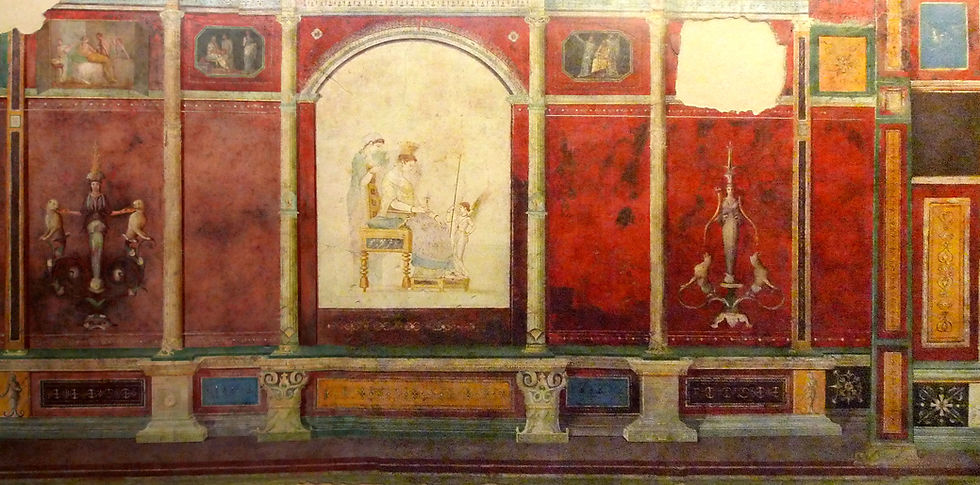
Red is the colour we most strongly associate with Pompeian wall painting – and rightly so. The characteristic ‘Pompeian red’ is an iron oxide pigment, more specifically haematite (Fe₂O₃), which occurs naturally in large quantities and was obtained quite simply by grinding and sieving. Depending on water content and additives, iron oxides produce a vast range of shades: from pale yellow through orange-red to a deep, cool violet-brown.
Even more vibrant, but also more expensive and dangerous, was cinnabar – mercury sulphide (HgS). Cinnabar is highly toxic, but produces a red of an intensity unmatched by any other ancient pigment. The most important European source of cinnabar was in Almadén, Spain, where the Romans had already been mining it on a large scale. The Pompeian painters used cinnabar particularly for accents and in prestigious rooms – it was the most expensive pigment of its time and, accordingly, a symbol of wealth and status.
Red ochre, a naturally occurring iron oxide compound, was the cheaper, ubiquitous counterpart. It has been used since the Stone Age and is found in many rock formations worldwide.

Yellow & Ochre: Yellow Ochre and Auripigment
Yellow ochre (Fe₂O₃·H₂O) is one of the oldest and most widely used pigments in human history. It is a hydrated iron oxide that occurs naturally all over the world and is available in shades ranging from a soft pale yellow to rich orange tones. In ancient wall painting, ochre was ubiquitous: as a background colour, for flesh tones, and for architectural elements.
Auripigment – arsenic sulphide (As₂S₃) – produced a luminous, almost metallic-looking golden yellow and was mined in the Balkans and the Middle East. It was used particularly at Tell el-Amarna in Egypt; the Romans and Minoans did not use it. It is rare and highly toxic, which meant that it was scarcely used after antiquity.

Blue: Egyptian Blue – the world’s first synthetic colour
This is where things get particularly interesting. Blue minerals suitable for use as pigments are extremely rare in nature.
Lapis lazuli is one of the oldest and rarest raw pigment stones. In ancient times, only deposits in Afghanistan and China were known. As the stone also contains inclusions of pyrite and calcite, it is very labour-intensive to purify the mineral in order to obtain the brightest possible blue.
The solution was one of the most remarkable achievements of ancient materials science: the invention of Egyptian Blue.
Egyptian Blue is the world’s oldest synthetically produced colour pigment. As early as 3200 BC, Egyptian craftsmen produced the pigment by mixing quartz sand, limestone, copper ore and an alkaline plant ash, and firing the mixture at temperatures of around 850 to 1000 degrees Celsius. This process produced the mineral cuprorivite (CaCuSi₄O₁₀) – a copper-calcium silicate of an intense blue colour, which, thanks to its layered crystal structure, even produces a slight glittering effect.
The Romans adopted this knowledge from the Egyptians and established their own production facilities. Archaeological finds provide evidence of workshops in Campania – that is, in the region around Pompeii. The Romans called this pigment ‘caeruleum’ and it was one of the most important blue pigments of its time. Ironically, the mineral cuprorivait occurs in nature almost exclusively in Vesuvius – the very volcano that buried Pompeii.
In 2025, an international team of researchers succeeded in fully recreating the ancient manufacturing process, discovering that even small variations in temperature and mixing ratios significantly altered the shade. This is why ‘Egyptian Green’ also exists.

Green: Green Earth and Malachite
Ancient painters relied primarily on two sources for shades of green. Green Earth is a natural clay mineral that was mined in various locations around the Mediterranean, particularly on the island of Cyprus and in Tuscany. It derives its colour from iron(II) silicates such as seladonite or glauconite. It produces a muted, slightly dull green – perfect for landscapes, plant decorations and backgrounds.
Malachite, the bright green copper mineral (Cu₂CO₃(OH)₂), produced richer, more vibrant tones. However, it had to be coarsely ground – when finely ground, malachite loses its colour intensity and turns greyish. Malachite was mined in what is now Egypt, on the Sinai Peninsula and in other copper-rich regions, and was widely traded throughout the Mediterranean. Malachite is a weathering product of the blue azurite and therefore only occurs alongside it.

Black & White: Soot, Bone and Lime
Black was easy to produce: by burning wood, vine shoots or bones. Bone black, made from burnt bones and ivory, produced a deep, warm black with a slightly bluish undertone. Vine black, made from charred vines, was another common black. Both are carbon-based pigments of great stability.
For white, ancient painters mainly used chalk or lime white (calcium carbonate) – the same substance as plaster, finely ground and mixed with water. In addition, there was white lead (2PbCO₃·Pb(OH)₂), which produced a particularly opaque, creamy white. White lead was known to be toxic, but was nevertheless used because of its painterly qualities.

4. Where did the pigments come from?
What particularly fascinates me about the colour palette of antiquity is its global nature. The pigments came from local quarries, but they were also commodities that were sometimes transported over thousands of kilometres and were thus part of a vast trade network.
Iron oxides were locally available – iron-oxide-bearing rock strata are found across much of the Mediterranean region, and for most painters it was no problem to find good red or yellow ochre in the immediate vicinity. Green earth was also readily available regionally, particularly in Italy and on the Aegean islands.
The situation was quite different for cinnabar: the main European mining sites were in Almadén in Spain, Idrija in Slovenia and Tuscany. Researchers have used lead isotope analysis to trace the cinnabar from Pompeii back to precisely these sources – a fascinating example of how modern science reconstructs ancient trade routes.
Egyptian blue long had a clear centre of origin: Egypt, where knowledge of its production was concentrated. It was not until around 70 BC that the first production site on Italian soil was established, near Puteoli (today’s Pozzuoli near Naples) – in other words, in the immediate vicinity of Pompeii. This meant that the pigment could be produced locally for centuries.
Malachite and copper minerals came from various sources: the Sinai Peninsula, Cyprus (which, not coincidentally, takes its name from copper – *cuprum*), the Balkans and North Africa. Copper was a staple of the ancient economy, and its by-products – green and blue copper minerals – naturally found their way into artists’ studios as well.

5. Binders: What keeps the paint on the wall?
Pigments alone do not make paint – they need a binder to hold them together and adhere them to the substrate.
The basic technique used by the Romans and Minoans was fresco painting – that is, painting on freshly applied, still-damp lime plaster. As the plaster dries, calcium hydroxide (Ca(OH)₂) migrates to the surface and reacts with carbon dioxide in the air to form calcium carbonate (CaCO₃). The pigments are literally encased in this limestone and thus permanently fixed. No additional binder is required – the plaster itself performs this function.
This technique has one crucial catch: it requires precise timing. The painter must plan their daily workload carefully and paint the fresh plaster completely before it dries – which, depending on the weather and room temperature, can take just a few hours. Details, corrections and colours that are incompatible with lime were therefore applied to the already dried plaster using the so-called secco technique – where binders were necessary.
Eggs (egg yolks or egg whites), animal glue, casein derived from milk and cheese, and occasionally wax were used as binders for secco sections. In Pompeii, there is evidence of the encaustic method, in which pigments were worked into heated beeswax – a labour-intensive technique that produced particularly glossy, melt-like surfaces.
Minoan plaster had a distinctive feature: in addition to lime and sand, it also contained animal hair – probably goat hair – which gave the plaster a certain flexibility and prevented cracking. According to research findings, this technique was so characteristic that Minoan frescoes found in oriental palaces in Syria and Egypt could be clearly identified as the work of Cretan muralists. Presumably, the addition of animal hair gave the plaster on earthquake-prone Crete greater flexibility and thus a longer lifespan.
ceiling in the temple of Hathor in Dendera fabric pattern in a minoan wallpainting from Knossos The blue room in Pompeji ©abacapress
6. Minoan - Roman - Egyptian: three painting techniques in comparison
Although all three cultures have left behind magnificent wall paintings, they differ in technique and colour palette in fascinating ways.
The Minoans, who reached their artistic peak between around 2000 and 1450 BC, painted on a stuccoed plaster surface, which often comprised several carefully smoothed layers. Their colour palette was fresh and vibrant: deep blue, bright yellow and warm red.
Pompeian wall painting, which developed in four styles from around 200 BC to 79 AD, is more dramatic, architectural and illusionistic. The colour palette is richer and bolder, the backgrounds often rendered in deep red or black, and the painters mastered shading, perspective and lighting effects with impressive sophistication.
Egyptian muralists, on the other hand, generally did not use the fresco technique, but rather the so-called secco technique: they painted on plaster that had already dried or directly onto stone. The surface was also often designed to resemble a relief. This meant that the paint was not incorporated into the surface but lay on top of it – held in place by a binder, usually animal glue, gum arabic or egg. The advantage of this method was its enormous flexibility: artists could work and make corrections at their leisure. The al-secco technique also allowed for a greater variety of colours, as pigments could be used that would not have been compatible with fresh alkaline lime. The fact that these paintings are in such good condition today is primarily due to the fact that Egyptian wall paintings were mainly executed in enclosed burial chambers and temples. This meant they were protected from light, weathering and destruction.
Another difference lies in the use of Egyptian blue: whilst the Minoans were familiar with it and used it – they were in close contact with Egypt via trade routes – the Pompeian painters used it even more extensively and with greater opacity. Extraordinary quantities of the pigment were found in the Pompeian ‘Blue Rooms’. Ironically, although Egyptian Blue had been invented in Egypt itself, even there it was one of the precious pigments used with great care.
What unites all three cultures is their mastery of colour and their choice of chemically stable pigments – and the result is that we can still admire their works today, whether in the burial chambers of the Nile Valley, the palaces of Crete or the buried villas of Pompeii.

7. Summary
The pigments used in the Mediterranean region in ancient times are therefore still in use today. Some earth pigments, such as ochre or iron oxide red, are used more frequently than others, and the colour spectrum has been vastly expanded by the chemical production of dyes. Classic binders such as bone glue, casein or egg are also still used today, albeit often only by conservators and artists with an interest in history. Frescoes, too, are rarely produced anymore due to the considerable effort involved. Unlike us, who have every conceivable pigment at our fingertips with a single click, people in the Bronze Age and the Roman Empire were dependent on local deposits and trade. This resulted in a hierarchy of availability: pigments that were easy to obtain, such as white chalk, black soot or yellow and red ochre tones, were used more frequently than rarer shades of green or blue.
And if you now feel like delving even further into the world of colours, do pop into my shop: each motif is accompanied by an informative text about its origin and distinctive features.

Comments